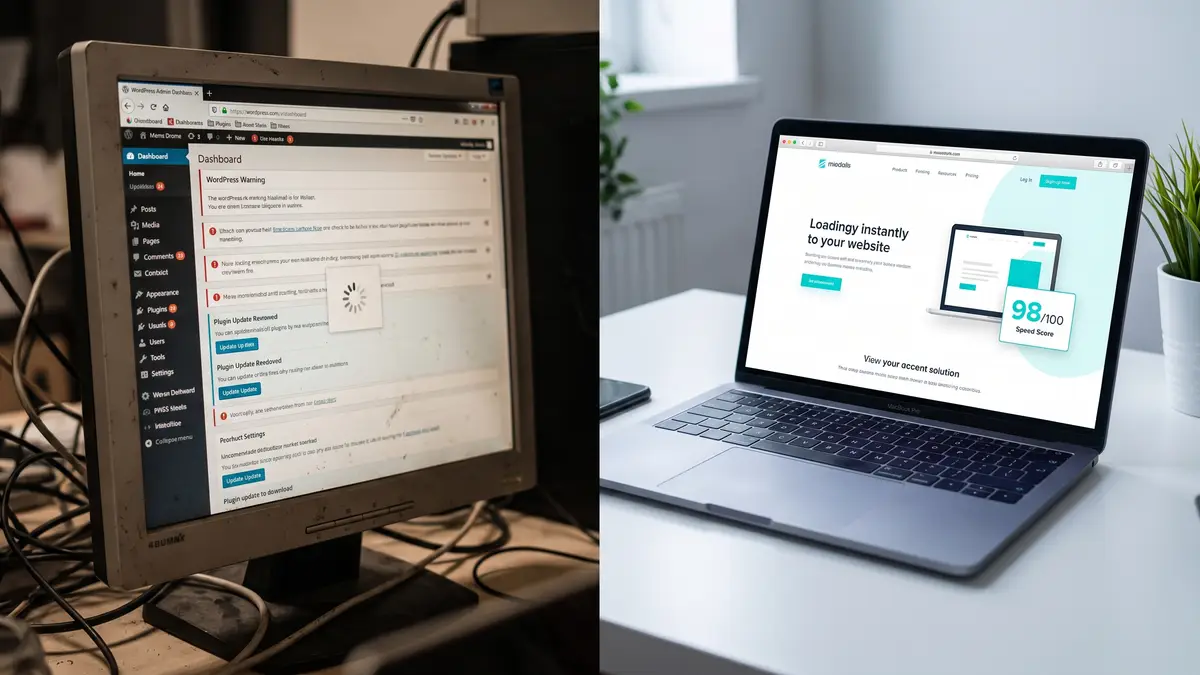
If your McAllen business has a website, there's a 70% chance it runs on WordPress. That's not a guess — WordPress powers roughly 43% of all websites worldwide, and in the small business market, it's even more dominant. For years, it was the right choice. Cheap hosting, thousands of plugins, drag-and-drop builders. You could get something live quickly.
The problem is that “live” and “working” are not the same thing. In 2026, the average WordPress business site loads in 3–5 seconds, gets hacked regularly, requires constant plugin maintenance, and scores 40–70 on Google Lighthouse — the measurement that correlates directly with search rankings and conversion rates. McAllen business owners are noticing, and the ones who care about growth are making the switch.
This article explains exactly what Next.js is (without the jargon), why it outperforms WordPress in every category that matters for a business, and what the migration actually looks like. If you've been wondering whether your RGV business should make the switch — here are the facts.
The WordPress Problem for RGV Businesses
WordPress was built in 2003 as a blogging platform. It was retrofitted over the years into a general website builder — and that retrofitting shows. Every performance limitation, every security vulnerability, every maintenance headache traces back to an architecture that was never designed to power a modern business website in 2026.
Key Fact
Here's what RGV business owners deal with on WordPress every month:
- →
Plugin update roulette. The average WordPress site runs 20–30 plugins. Every update is a gamble — a plugin update that conflicts with your theme can take your entire website down. We get calls about this every week from McAllen businesses.
- →
Constant security threats. WordPress powers 43% of the internet, which makes it the #1 target for hackers. Over 90,000 WordPress sites are hacked every day. Not because of bad owners — because of a fundamentally vulnerable architecture with a public database and an admin login page at a predictable URL.
- →
Shared hosting speed limits. Most McAllen businesses host their WordPress site on GoDaddy or Bluehost shared hosting — $8–$15/month plans where your site shares a server with hundreds of others. When your neighbor gets traffic spikes, your site slows down. WordPress on shared hosting routinely scores under 50 on mobile PageSpeed.
- →
Bilingual is an expensive afterthought. In the RGV, bilingual websites aren't optional for most businesses. WPML — the most popular WordPress multilingual plugin — costs $99/year, slows your site further, and still produces clunky URL structures that confuse Google. Real bilingual architecture requires a better foundation.
What Is Next.js? (No Jargon Version)
Next.js is the framework used to build websites for Netflix, Nike, TikTok, Hulu, and thousands of other high-traffic companies that cannot afford slowness. It's built on React — the same technology Facebook runs on — and maintained by Vercel, a company funded by Google, Stripe, and Tiger Global.
Here's the plain-English version of why it's faster: WordPress builds your pages on demand every time a visitor arrives — pulling from a database, running PHP, assembling HTML, serving it. That process takes time. Next.js pre-builds your pages ahead of time and serves them instantly from a global CDN. No database query. No PHP execution. No waiting.
What this means for your McAllen customers: your page loads before they finish blinking. No 3-second wait that costs you 53% of visitors. No spinning loader. Just instant.
The other advantages follow from the same architecture:
- ✓No database to hack — there's no WordPress admin URL, no login page to brute-force, no public database. Static files served from a CDN have no attack surface.
- ✓No plugins to update — features are built into the code, not bolted on via third-party plugins that conflict with each other.
- ✓Built-in image optimization — next/image automatically serves WebP, resizes for each device, and lazy-loads below-the-fold images. Zero configuration.
- ✓Bilingual built into the architecture — Next.js has native internationalization routing. /services and /es/servicios live at clean URLs with proper hreflang tags. No WPML, no annual fees.
- ✓Deploys globally in seconds — every update goes live via Git. No FTP, no cPanel, no waiting for server propagation.
WordPress vs. Next.js: Side by Side
Numbers don't lie. Here's how the two platforms compare across every metric that affects your McAllen business's growth.
| Metric | WordPress (typical) | Next.js (ThunderLoud) |
|---|---|---|
| Mobile load time | 3–5 seconds | Under 1.5 seconds |
| Google Lighthouse score | 40–70 | 90–100 |
| Security | Constant plugin vulnerabilities | No database, no attack surface |
| Bilingual (EN/ES) | $99/yr WPML + slow | Native routing, included |
| Monthly maintenance | Plugin updates, backups, patches | Zero — no plugins, no CMS |
| SEO performance | Limited by speed + plugin bloat | Core Web Vitals optimized |
| Hosting cost | $8–$40/month shared hosting | Free on Vercel (hobby tier) |
Key Fact
Free — No Commitment
See the Difference
Our McAllen website redesign takes your WordPress site to Next.js in 14 days — with full SEO preservation, 301 redirects, and zero downtime during the switch.
Get My Free Website Review →“But I Know WordPress — Do I Need to Learn Next.js?”
This is the most common concern we hear from McAllen business owners — and the answer is no. You don't need to know a single line of code. You never touch the codebase. You never log into a developer interface. Your job after launch is exactly the same as it was with WordPress: run your business.
For most small businesses in the RGV, the content on their website changes rarely — maybe a phone number, a price, a new service offering. When that happens, you tell us and we update it, typically same day. No plugin conflicts. No “your theme isn't compatible with this WordPress version” nightmare. No white screen of death.
If you've been using WordPress for blogging and need a CMS to manage your own posts, we can wire that up too — there are headless CMS options (Sanity, Contentlayer) that give you a clean editing interface without putting WordPress in the critical path of your site performance. But for most McAllen service businesses — restaurants, contractors, salons, accountants — a static Next.js site with a low-cost maintenance plan handles everything.
What the Switch Actually Looks Like
The migration process is straightforward. Here's what happens from the moment you contact us to the moment your new Next.js site goes live.
Audit your current WordPress site
We crawl every page, identify which URLs have rankings worth protecting, flag plugin dependencies, and document all existing content. You get a clear picture before we touch anything.
Export and organize content
We pull all your existing content — pages, images, copy, meta descriptions — out of WordPress. Nothing gets lost. Everything valuable carries over.
Build your custom Next.js site in parallel
Your old WordPress site stays live and functional the entire time we're building. Zero downtime, zero disruption to your business. Customers can still find you and contact you.
Map and set up 301 redirects
Every URL from your old site gets a 301 redirect to its new equivalent. Google sees this as a move, not a deletion. Your rankings transfer. This is the most important step for SEO preservation — and the one most freelancers skip.
Review and approve
You see the new site before it goes live. Two rounds of revisions included. We don't flip the switch until you're happy.
Deploy and monitor
We switch your domain to the new Next.js site, verify all redirects are firing, submit the new sitemap to Google Search Console, and monitor for 30 days. Your McAllen business is live on modern infrastructure.
Total timeline: 14 calendar days. Start to finish. The same process that big San Antonio agencies charge $5,000–$10,000 for and take 3 months to complete. If you're comparing options, our Wix vs. custom website breakdown covers the same decision framework for businesses on Wix instead of WordPress.
Is the Switch Worth It for Your McAllen Business?
If your WordPress site scores under 70 on mobile PageSpeed, takes more than 2 seconds to load on a 4G connection, or hasn't had a design update since before the pandemic — yes. The math is simple. A slow website costs you leads every day it runs. The longer you wait, the more you've paid in missed business.
The Valley is increasingly competitive online. The businesses on South 10th Street, in Edinburg Medical District, and around La Plaza Mall that upgraded their web presence in 2024 and 2025 are showing up in Google searches that their slower competitors can't touch. WordPress vs. Next.js is rapidly becoming the same gap as having a website vs. not having one — and that gap matters.
Our McAllen website redesign service is the fastest path from WordPress to a Lighthouse 90+ Next.js site. Starting at $1,497, delivered in 14 days, with full SEO preservation and a satisfaction guarantee. Or compare it alongside our full range on the website redesign services page.
This article is for general informational purposes. For guidance specific to your business, consult a qualified professional.